

Carbon Fiber for Drones & Robotics

Carbon fibre is increasingly specified in robotics because it delivers high stiffness and strength at a fraction of the mass of metals. For OEMs and integrators, this translates directly into shorter cycle times, higher payload for a given motor/gearbox, improved positional accuracy, and lower energy consumption. As a manufacturer of carbon fibre components, we design and produce parts that meet the mechanical, thermal, and cleanliness demands of industrial, collaborative, mobile, and precision robotics.
Typical applications include:
Robot arm links, delta robot arms, and booms (filament‑wound tubes and tailored laminates)
End-of-arm tooling and grippers, vacuum plates, nests, and EOAT backplates
Gantry and linear-stage crossbeams, pick-and-place frames, and vision system mounts
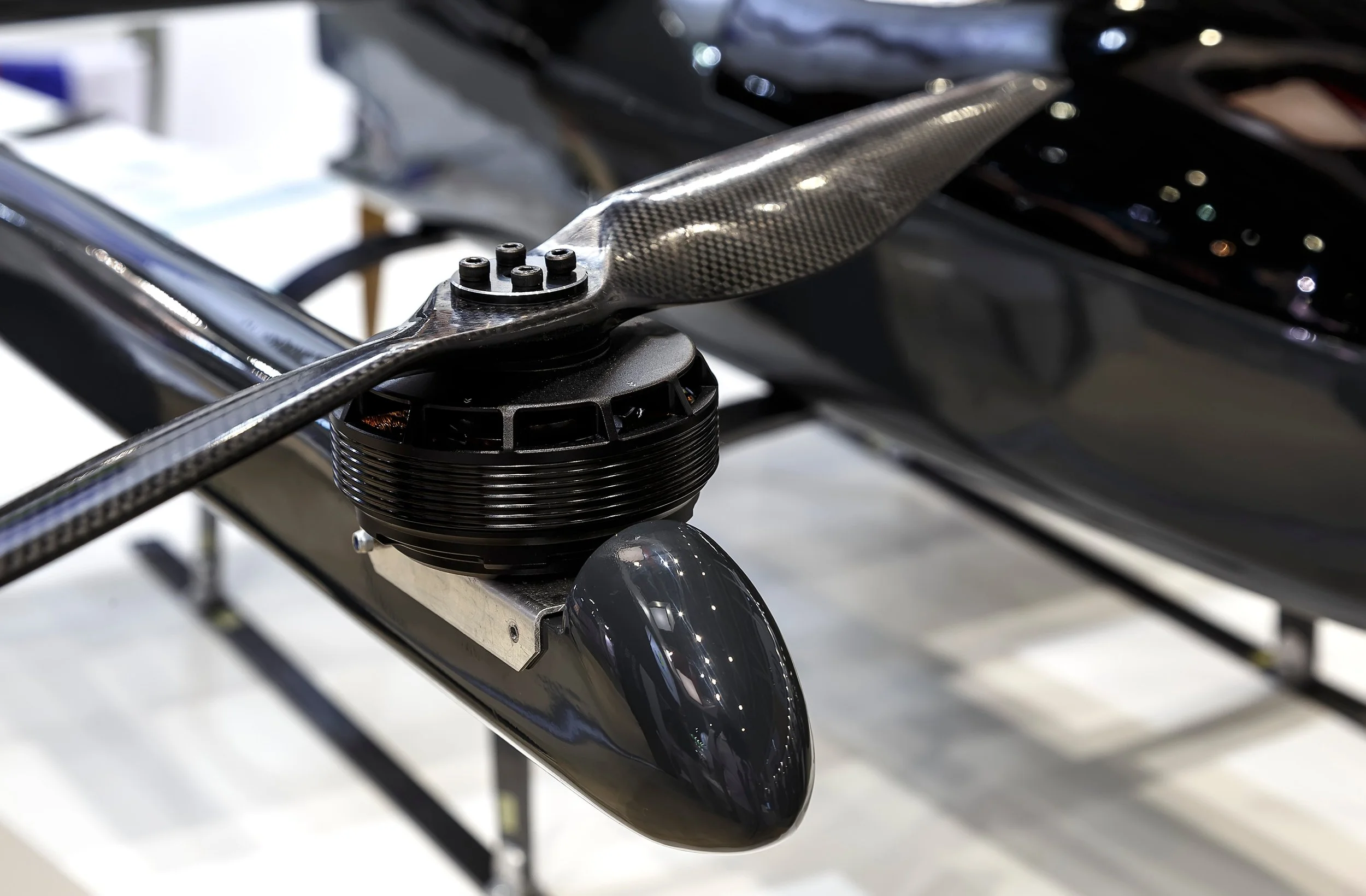
AMR/AGV chassis and superstructures; UAV frames and landing gear
Metrology-grade fixtures, sensor brackets, and optical benches
Housings, exoskeleton components, and covers where low mass improves ergonomics
Performance advantages are measurable. Replacing aluminum links with carbon fibre can cut component mass significantly while maintaining or increasing stiffness, reducing link inertia and motor torque requirements. Lower inertia raises allowable acceleration and deceleration, shortens settle times, and increases throughput. High specific damping in composite structures reduces vibration transmission to the end effector, improving path accuracy and reducing overshoot. Carbon fibre’s low, tailorable coefficient of thermal expansion (as low as ~0–2 ppm/°C along fibre direction, versus ~23 ppm/°C for aluminum) helps preserve calibration in temperature-varying environments. Corrosion resistance and excellent fatigue performance extend service life in demanding duty cycles.
Design flexibility is a key benefit. Composite layups can be oriented to place stiffness and strength along load paths, creating anisotropic structures that outperform isotropic metals at equal mass. Sandwich constructions with honeycomb or foam cores deliver very high bending stiffness for gantry beams and EOAT plates. Filament‑wound tubes provide high axial stiffness and buckling resistance for arms and booms. Quasi‑isotropic laminates are used where uniform properties are required. We routinely integrate metallic inserts, threaded bosses, and wear surfaces, and we engineer bonded and bolted joints to manage load transfer and durability.
Manufacturing processes are selected to meet performance and cost targets: autoclave-cured prepregs for maximum properties and repeatability; filament winding and pultrusion for tubes and profiles; out-of-autoclave and compression moulding for volume parts; precision CNC trimming and drilling of cured laminates for tight tolerances. Quality assurance includes dimensional inspection (CMM), laminate verification, and non-destructive inspection when required.
Integration considerations are handled in the design phase. We manage galvanic isolation between carbon fibre and aluminum/steel to prevent corrosion. Electrical conductivity of carbon fibre can be leveraged for ESD control or mitigated with dielectric barriers where insulation is needed. Edges and surfaces can be sealed and coated for cleanroom compatibility and low particulate generation; low-outgassing resin systems and adhesives are available for vacuum applications. Internal routing for pneumatics, vacuum, and cabling can be built into the structure, reducing external clutter and snag points.
We supply prototypes through series production, working to print or collaborating from concept to final design. Our engineering team provides FEA-driven layup design, material selection, and joint design support to achieve the targeted stiffness, mass, and dynamic response. The result is carbon fibre components that drop into your robot architecture, improve performance immediately, and maintain reliability in the field.
If you’re looking to reduce mass, increase rigidity, or push cycle times without upsizing actuators, carbon fibre parts are a proven path. We build them to perform consistently and at scale.